
No products in the cart.

Edge AI Security Monitoring for Remote & Off-Grid Sites
Build event-triggered security monitoring workflows with CamThink edge AI hardware — from visual sensing nodes to local inference, flexible connectivity, and open integration for your existing platform or system integrator.
Event-First
Trigger-based inference
On-Device AI
No cloud dependency
OTA
Remote model update
Multi-Node
Fleet-managed
Why Remote Security Monitoring Needs Edge AI
Off-grid and temporary security sites often face power, connectivity, latency, and model flexibility limits that traditional cameras and cloud-first AI platforms struggle to support.
01
Power and Connectivity are Absent or Unreliable
Remote sites may lack mains power, fixed network access, or stable LTE coverage. Continuous video streaming can increase bandwidth cost and reduce deployment reliability.
02
Cloud-Only AI Adds Latency and Dependency
Sending images or video upstream for every detection can introduce latency, recurring processing cost, and network dependency. Local inference helps keep key detection logic closer to the site.
03
Fixed AI Models Limit Custom Use Cases
Standard cameras usually ship with predefined models. Integrators building specialised applications need hardware that supports model adaptation or custom deployment.
Built for Event-Driven Edge Security
From event-triggered capture to local AI inference and open integration, CamThink hardware gives integrators the building blocks to deploy practical security monitoring workflows.

Event-Triggered Capture
Wake on PIR, GPIO, or motion-based events instead of streaming continuously. This helps reduce power use and supports battery, solar, or temporary site deployments.

Local AI Inference
Run AI inference on the device to reduce network dependency, lower alert latency, and keep key detection logic closer to the site. Output detection results for downstream alert workflows.

Custom AI Models
Deploy custom detection models for specialised security or operational use cases. Integrators can adapt the AI workload for site activity, PPE, objects, or behaviour patterns.
Flexible Connectivity
Connect devices through Wi-Fi, HaLow, LTE, Ethernet, or supported network options based on site conditions. Choose the connectivity path that fits power, range, and deployments.
Remote Device Management
Support remote configuration, OTA updates, and diagnostics for distributed devices. This helps reduce site visits during PoC, pilot, and scaled security deployments.

Open Integration
Send events, images, metadata, and detection results to existing platforms. CamThink hardware can connect with VMS, alarm backends, dashboards, or customer-side systems.
Hardware Architecture for Multiple Deployment Modes
From low-power visual nodes to fixed AI cameras and edge compute, CamThink hardware can be combined based on site conditions, AI workload, and integration requirements.
Standalone Edge Monitoring
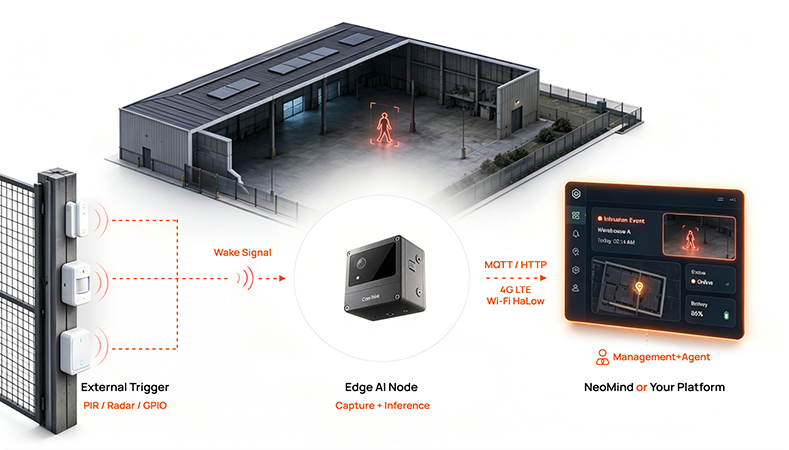
Deploy a self-contained edge AI node for temporary, remote, or off-grid security points where wiring, fixed networks, or continuous video streaming are not practical. The device can wake from PIR, GPIO, motion, or scheduled triggers, run local detection on-site, and send image evidence, event metadata, or alert-ready outputs to your platform.
Best for: temporary perimeters, remote assets, vacant properties, and battery or solar-powered monitoring points.
Best for: temporary perimeters, remote assets, vacant properties, and battery or solar-powered monitoring points.
Distributed Nodes with Edge Compute
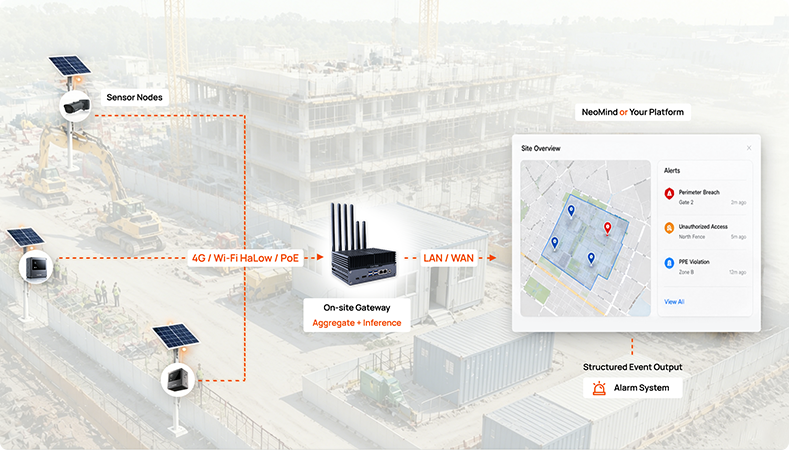
Cover larger sites with multiple low-power visual nodes while keeping heavier processing, storage, or uplink resources centralized. Nodes can capture event images or metadata and send them to an on-site edge compute unit, where local processing, event aggregation, or platform upload can be handled before data reaches your VMS, alarm backend, or customer system. Best for: multi-point sites, construction areas, industrial yards, warehouse zones, and deployments where every camera point does not need full AI compute or cellular connectivity.
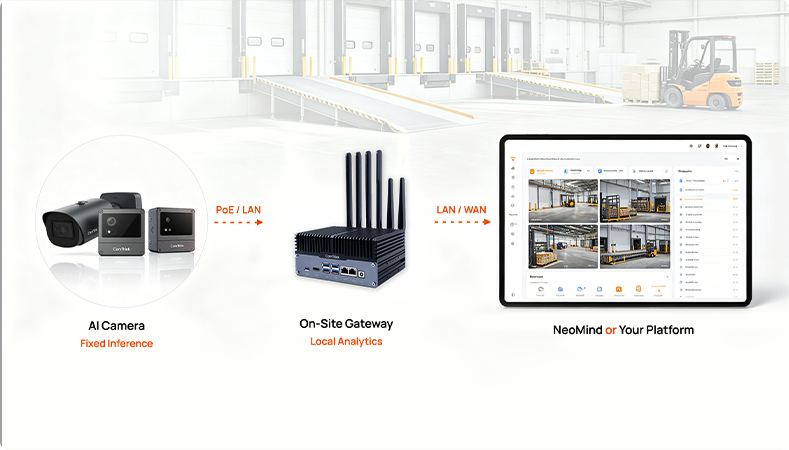
Fixed AI Camera Monitoring
Use PoE-powered AI cameras for permanent sites that require continuous detection, stable network access, or higher-performance models. Each camera can process events on-site and output video, images, detection results, or metadata into existing VMS, alarm, or security systems, while optional edge compute can support local storage, aggregation, or multi-camera processing. Best for: entrances, restricted areas, warehouses, equipment zones, parking areas, and other fixed monitoring locations.
Security Scenarios Supported by CamThink Hardware
CamThink edge AI hardware can support security monitoring across remote, temporary, and fixed deployments when connected to your VMS, alarm backend, or system integration workflow.

Vacant Property Monitoring
Detect intrusion at vacant or unattended sites with trigger-based capture, local AI detection, and image evidence.

Construction Site Security
Monitor temporary site zones for after-hours intrusion, equipment tampering, or restricted access as layouts change.

Retail Loss Prevention
Deploy AI-enabled monitoring in high-risk retail areas where fixed infrastructure is limited or fast installation is needed.

Fly-tipping Detection
Capture illegal dumping, vehicle unloading, or roadside activity with edge AI detection and event-based image records.

Remote Asset Protection
Protect remote equipment, vehicles, or field assets with low-power monitoring hardware for off-grid sites.

Industrial & Warehouse Security
Monitor access points, restricted zones, or hazardous areas with edge AI outputs for existing security systems.
Choose Your Security Monitoring Hardware
Each device plays a defined role in the hardware architecture. Integrators can combine visual sensing nodes, edge AI cameras, or edge compute based on deployment needs.
Low-Power Sensor Node
NE101
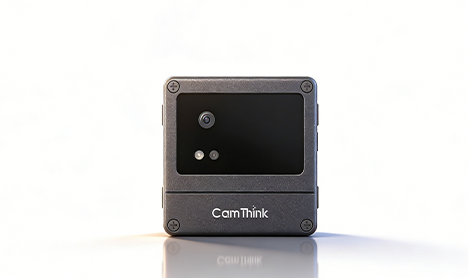
Low-power visual capture with PIR/GPIO-triggered wake, scheduled imaging, and MQTT transmission. Designed for remote points where battery life, solar power, or low data usage matters.
Edge AI Node
NE301
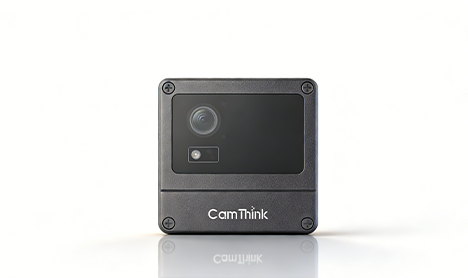
NPU-accelerated local inference with event-triggered wake and flexible network options. Works as an independent edge AI node for rapid deployment, off-grid monitoring, and alert-ready output.
Edge AI Gateway
NG4500
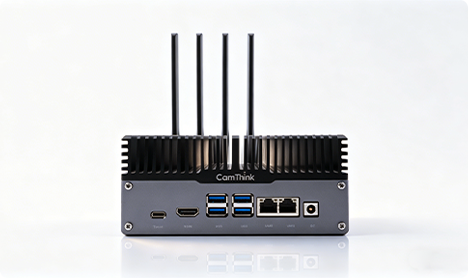
Edge compute hardware for centralized AI processing, local storage, and multi-device aggregation. Supports heavier inference workloads when multiple visual nodes or cameras need on-site processing
Edge AI Node
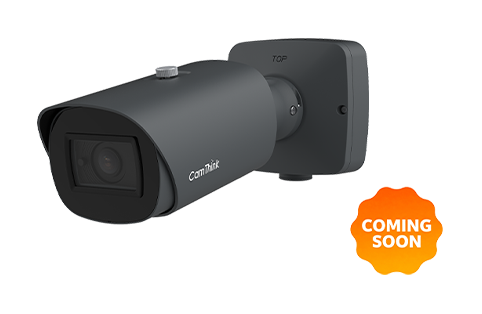
NeoEyes NE503
PoE-powered AI camera for fixed-site monitoring, continuous detection, and higher-performance models. Supports 4K imaging, on-device NPU inference, and application deployment for permanent installations.
Interested in early access?
Open by Design. Ready for Your Stack.
If you already have an AI platform, alarm backend, VMS, or integration workflow, CamThink hardware can sit at the edge and feed your existing stack. No proprietary middleware required.
01
Open Device Access
CamThink hardware supports configurable firmware behavior, GPIO settings, and sensor interfaces, helping integrators define device-side logic without being limited by closed camera systems.
02
Standard Data Protocols
Events, images, and metadata can be delivered through standard protocols such as MQTT and HTTP, enabling direct integration with existing AI pipelines, alarm systems, or customer platforms.
03
Remote Device Updates
Deploy firmware updates, AI model updates, or configuration changes remotely via OTA, helping teams maintain distributed hardware without frequent site visits.
04
Scalable Hardware Deployment
Start with a few devices for PoC, then scale using the same device outputs and integration approach. Hardware roles can expand without rebuilding the entire workflow.
Get in Touch
Tell us about your integration project, hardware evaluation, or custom requirements. Fill out the form below, or email our team directly at sales@camthink.ai
Loading form...
The form is taking longer than expected to load.
Please try refreshing, or email us at sales@camthink.ai
Explore Related Resources
Edge AI vs Standard 4G Cameras for Construction Site Security
A practical comparison for temporary and off-grid sites. See how on-device AI helps reduce false alarms, LTE data usage, and cloud dependency while supporting custom detection and system integration.
Read the Article →Evaluate The Hardware
Order evaluation units to test integration, AI performance, and power behavior before scaling.
Go to Store →Explore Documentation
Review firmware architecture, APIs, MQTT payloads, GPIO interfaces, and NeoMind integration guides.
Open Docs →Ready to Evaluate for
Your Deployment?
Discuss Your Deployment
Talk to our team about multi-site deployments, custom hardware, connectivity requirements, or application-specific AI models.
Go to BlogEvaluate The Hardware
Order evaluation units to test integration, AI performance, and power behavior before scaling.
Go to StoreExplore Documentation
Review firmware architecture, APIs, MQTT payloads, GPIO interfaces, and NeoMind integration guides.
Open Docs